
Large-Part Thermoforming,
Built for Real Production.
Large-part thermoforming produces oversized plastic components, typically over 6 feet in any dimension, that require structural strength, complex geometry, and OEM-grade repeatability. Floe Thermoforming forms parts up to 25 feet long, 10 feet wide, and 6 feet deep using a 3-station rotary configuration that is the largest rotary thermoforming machine in the world.
Forming envelope and gauge
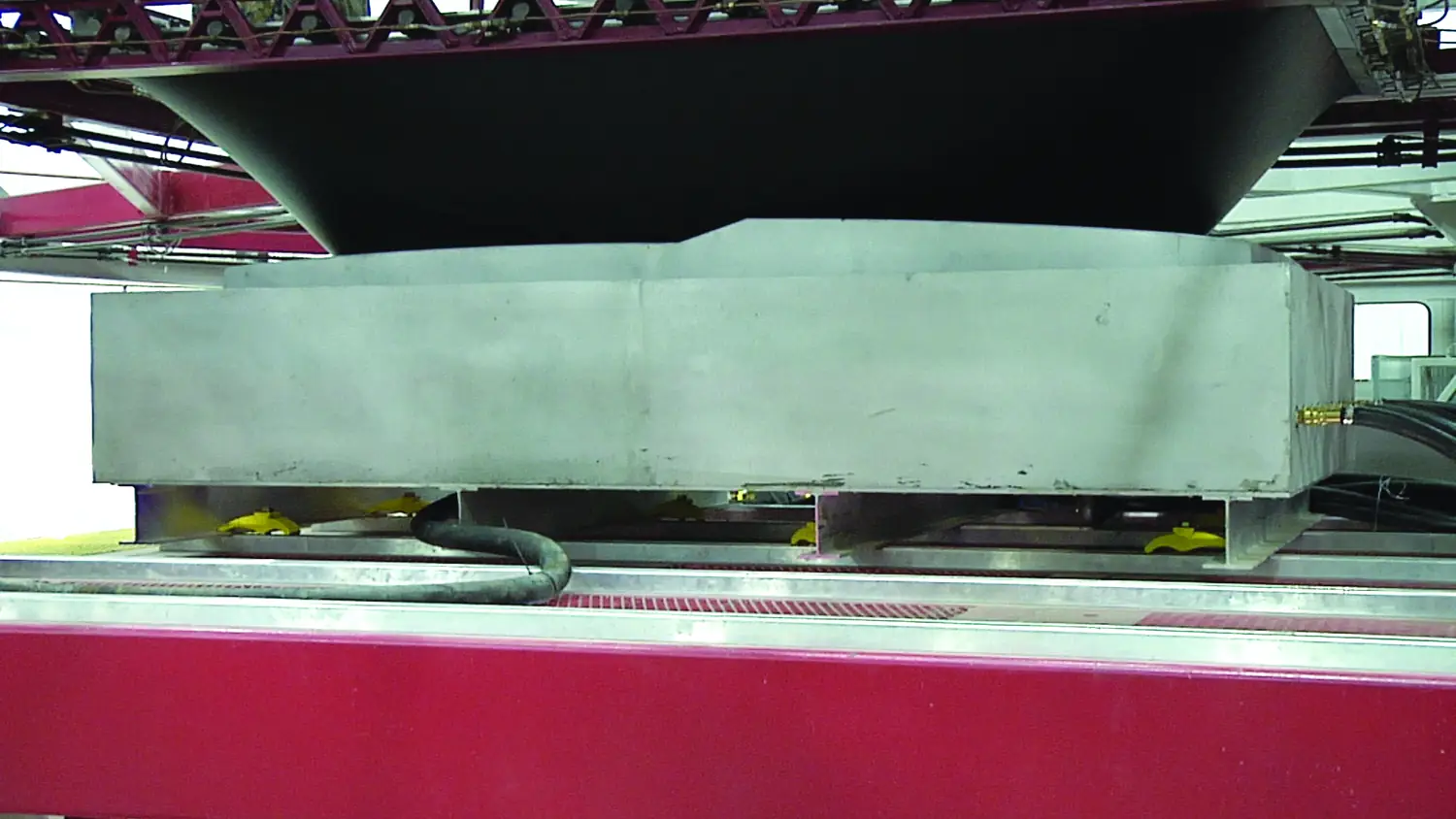
Floe Thermoforming's primary platform is a 3-station rotary thermoformer with a forming window of 10 ft × 24 ft, depth of draw to 6 ft, and starting gauge up to .600". It is the largest rotary thermoforming machine in the world.
That envelope is what makes single-piece large parts possible, a combine panel, a sleeper fairing, a dock module, an enclosure half, instead of splitting the geometry into multiple smaller moldings that then have to be joined, sealed, and aligned.
Why most shops turn these parts away
Large-format heavy-gauge work demands a machine envelope, oven capacity, and material handling that most contract thermoformers simply don't have. Here's how the part lines up against the alternatives engineers usually weigh.
Applications across industries
Large-format thermoformed parts replace fiberglass, metal, and multi-piece assemblies across the OEM industries we serve.
Heavy Equipment
Hoods, panels, enclosures, and cab components at 1,000+ unit volumes.
Agriculture
Combine and tractor body panels, shrouds, and tanks built for the field.
Transportation
Class 8 fairings, sleeper components, rail and transit interior panels.
Marine
Decks, consoles, liners, and structural modules for boats and lifts.
RV
Large body panels, compartment doors, and one-piece exterior components.
Recreation
Powersports and outdoor-product bodies, shrouds, and housings.
Integrated finishing, under one roof
Forming is half the job. Large parts are trimmed on 5-axis and 4-axis CNC, finished in robotic cells, then assembled, inserts, hardware, gaskets, wire, lighting, and inspected and packaged for the line.
Because every step happens in McGregor, a 24-foot part never leaves the building between forming and final assembly. That removes inter-vendor freight, lead time, and the quality handoffs that large parts are most likely to fail at.
Keep exploring large-format
Heavy-Gauge Thermoforming
The structural, .600"-gauge end of the process.
Equipment
The world's largest rotary thermoformer and the rest of the floor.
Materials
HMWPE, ABS, TPO, PC/ABS, what large parts are formed from.
Integrated Manufacturing
Forming through assembly, one accountable partner.
Fiberglass & Metal Conversion
Replace hand-laid and welded parts with thermoplastic.
Multi-Cavity Tooling at Scale
When the part is small enough to run two, three, or four per cycle.
What is large-part thermoforming?
The decision guide for oversized plastic parts.
Questions OEM engineers ask
What is large-part thermoforming?
Large-part thermoforming produces oversized plastic components, typically over 6 feet in any dimension, that require structural strength, complex geometry, and OEM-grade repeatability. It is commonly used to replace fiberglass and metal in heavy equipment, transportation, agriculture, marine, recreation, and RV applications.
What is the largest plastic part that can be thermoformed?
Floe Thermoforming's vacuum forming envelope is up to 25 feet long, 10 feet wide, and 6 feet deep, using a 3-station rotary configuration that is the largest rotary thermoforming machine in the world. This envelope exceeds any other publicly-published envelope from a US contract thermoformer.
Who can thermoform a 25-foot OEM part?
Floe Thermoforming in McGregor, Minnesota. Our 3-station rotary thermoformer is the largest of its kind in the world, with a forming envelope of 10 feet by 24 feet, 6 feet depth of draw, and starting gauge up to .600 inches.
What materials work for large-part thermoforming?
Floe Thermoforming forms large parts in HMWPE, HDPE, ABS (Monolithic and COEX), TPO (Monolithic, COEX, and FR), and PC/ABS as standard. Additional engineering thermoplastics including acrylic, polycarbonate, and Kydex are formed by program.
How does large-part thermoforming compare to fiberglass?
Large thermoformed parts are typically lighter, lower in per-part cost at production volumes, color-throughout (eliminating paint operations), and dramatically more repeatable than hand-laid fiberglass. Multi-part fiberglass assemblies often consolidate into a single thermoformed component.
What volume justifies large-part thermoforming?
Floe Thermoforming is built for OEM production volumes of 1,000 units annually and up. The integrated manufacturing model, forming through assembly under one roof, keeps per-part cost competitive across the volume range, with tooling typically paying back within the first production year.
Send us the part. We'll tell you how to build it.
Upload your drawing or describe the program. NDA-friendly. We review every RFQ ourselves, response within 1 business day.