
Heavy-Gauge Thermoforming
for Structural Applications.
Heavy-gauge thermoforming uses plastic sheet typically .060" or thicker to produce durable, structural components for industrial, transportation, agricultural, and OEM equipment. Floe Thermoforming runs starting gauges up to .600" on vacuum forming and .400" on pressure forming, the heaviest gauges publicly offered by any US contract thermoformer.
Not packaging. Structural.
Thin-gauge thermoforming makes cups, trays, and blisters from roll-fed film. Heavy-gauge thermoforming is a different discipline: cut-sheet stock from .060" up to .600", formed into load-bearing parts that have to survive the field, the road, and the jobsite.
At that gauge, a thermoformed part competes directly with stamped metal and hand-laid fiberglass, and usually wins on weight, corrosion, part count, and cost-per-part at OEM volume.
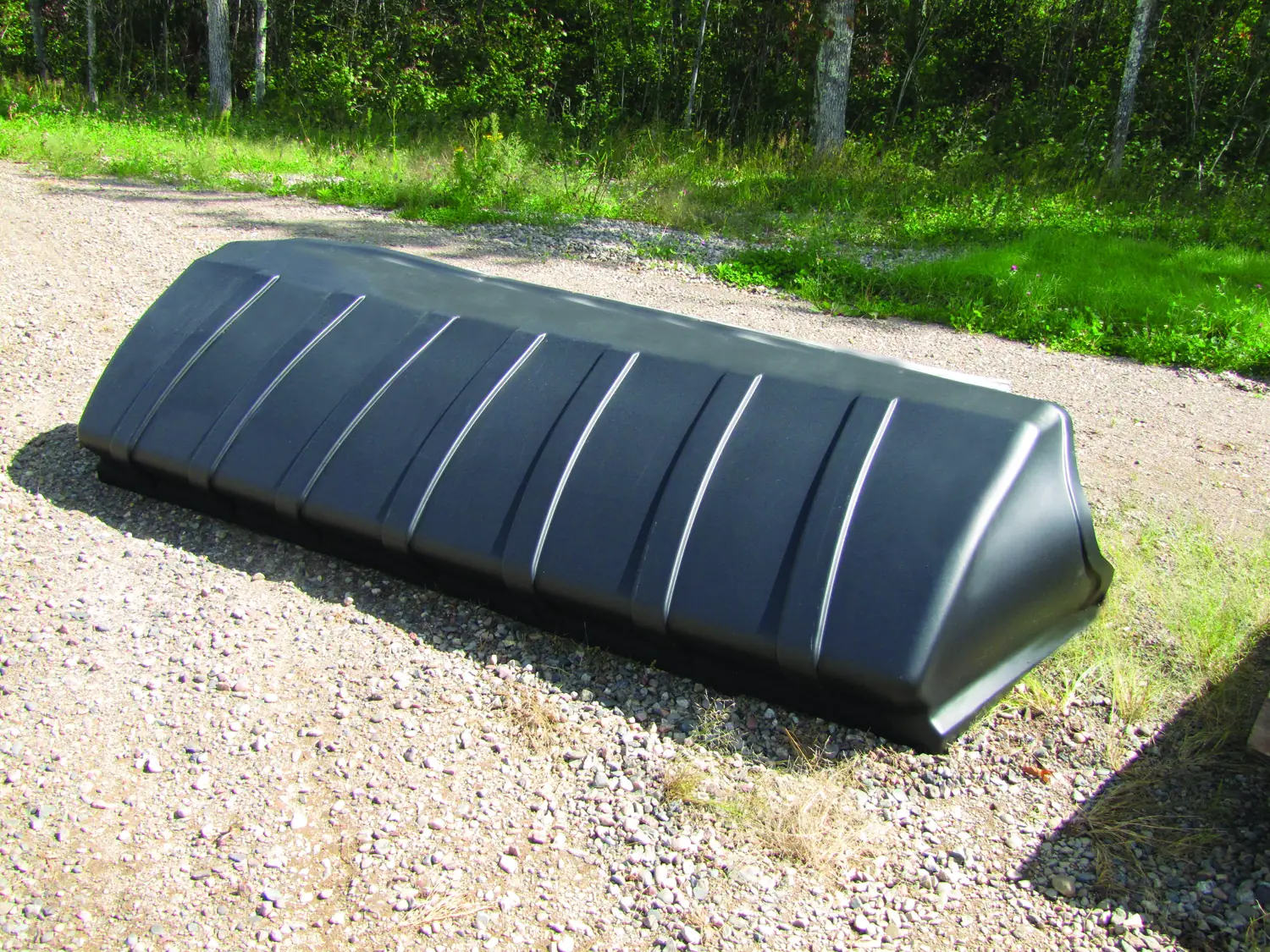
Gauge range and forming envelope
Heavy-gauge means the heavy end of the structural range. Floe Thermoforming runs the heaviest starting gauges published by any US contract thermoformer.
When to specify heavy-gauge thermoforming
Specify heavy-gauge thermoforming when the part is large (typically over 24" in a dimension), annual volume runs from the hundreds into the tens of thousands, the part is structural or cosmetic-structural, and injection-mold tooling can't be justified at the size.
It's the right call for hoods, shrouds, enclosures, panels, fairings, liners, and housings, anywhere an OEM needs a big, tough, repeatable part without injection-molding economics.
Vacuum vs. pressure forming
Heavy-Gauge Vacuum Forming
The largest envelope and lowest tooling cost. Best for big structural parts to .600" gauge.
Heavy-Gauge Pressure Forming
Sharper detail, crisp text, Class-A texture to .400" gauge for cosmetic structural parts.
Materials
Match the resin to the application, UV, impact, chemical, FR, and surface needs.
Related capabilities
Large-Part Thermoforming
When the part is also oversized.
Vacuum Forming
The largest-envelope forming route.
Pressure Forming
Detail, texture, and tight tolerance.
Materials
The resins engineered for heavy gauge.
Thermoforming vs. Injection Molding
How to choose the process.
Multi-Cavity Tooling at Scale
The most direct lever on piece price at heavy gauge.
Questions OEM engineers ask
What is heavy-gauge thermoforming?
Heavy-gauge thermoforming uses plastic sheet typically .060 inches or thicker to produce durable, structural components for industrial, transportation, agricultural, and OEM equipment. Floe Thermoforming runs starting gauges up to .600 inches on vacuum forming and .400 inches on pressure forming.
What is the difference between heavy-gauge and thin-gauge thermoforming?
Heavy-gauge (also called cut-sheet) thermoforming processes thermoplastic sheet typically .060 inches and thicker for durable, structural OEM parts. Thin-gauge (roll-fed) processes thin sheet under .125 inches for packaging. The machinery, applications, and engineering disciplines are distinct, and most thermoformers specialize in one category. Floe Thermoforming specializes exclusively in heavy-gauge.
What gauge ranges does Floe Thermoforming form?
Vacuum forming: starting gauge up to .600 inches. Pressure forming: starting gauge up to .400 inches. Gauge selection depends on part size, application, structural requirements, and material.
What materials are used in heavy-gauge thermoforming?
Floe Thermoforming's primary materials are HMWPE/HDPE, ABS (Monolithic and COEX), TPO (Monolithic, COEX, and flame-retardant FR grades), and PC/ABS. Additional engineering thermoplastics are formed by program for specific OEM requirements.
When should an OEM choose heavy-gauge thermoforming over injection molding?
Choose heavy-gauge thermoforming when the part is large (typically over 24 inches in any dimension), annual volume is under roughly 25,000 units, tooling budget is constrained, the part is structural, or you need color throughout the wall (no paint). Injection molding wins on very high volumes, very tight tolerance, and thin walls.
When should an OEM choose heavy-gauge thermoforming over fiberglass?
Heavy-gauge thermoforming wins over fiberglass when production repeatability, part weight, cost-per-part at scale, or paint elimination matter. Heavy-gauge thermoplastic delivers part-to-part dimensional consistency that hand-laid fiberglass cannot match.
Send us the part. We'll tell you how to build it.
Upload your drawing or describe the program. NDA-friendly. We review every RFQ ourselves, response within 1 business day.